
A Brief History of Calendars
with an introduction to astronomy

Computer scientist and creative technologist
About the Course
Join us on the adventure of inventing a new calendar, one that may be whimsical, practical, or revolutionary. This course takes you beyond the familiar grid of the Gregorian calendar into the bigger story of how it came to be, the historical alternatives that have been tried, and the possibilities for calendars better suited for modern times.
The story of calendars is grounded in astronomy. In particular, the orbit of the Earth around the Sun and the orbit of the Moon around the Earth. Both are more subtle and nuanced than what we are typically taught. These orbits, and their cycles, constrain how we define months and years. The definitions aren't absolute. This course provides an opportunity to explore other definitions, other choices. What would a calendar look like if we prioritized the Moon instead of the Sun? If a week had six days? if we tried to make a calendar that was the same every year, with a different strategy for leap years? What if we needed a calendar for a permanent colony on the Moon, where a day (sunrise to sunrise) lasts about 29.5 Earth days? How would a space travel calendar work for multi-generation voyages?
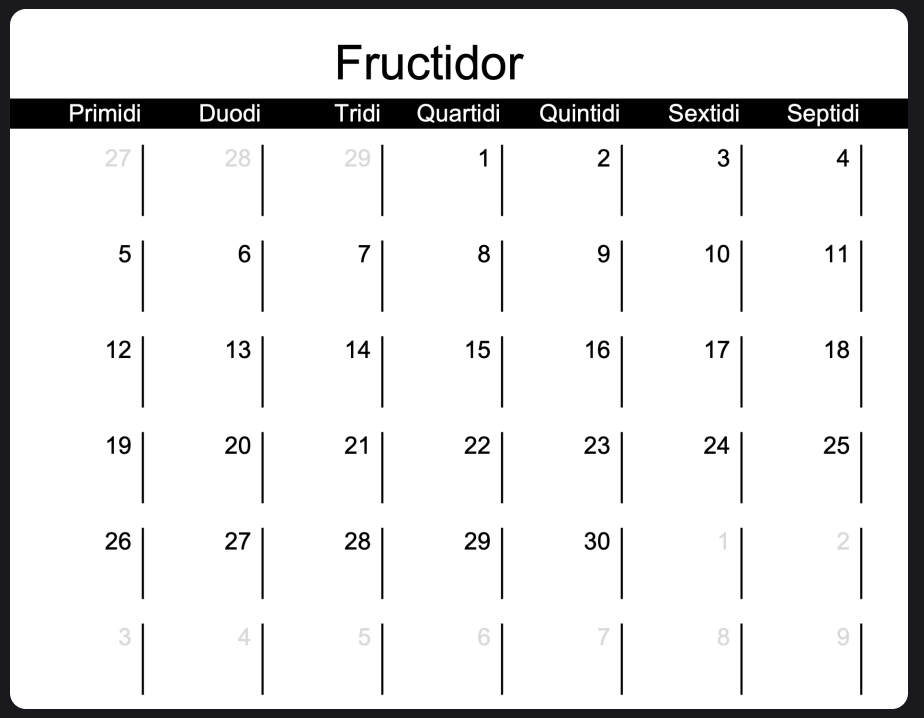
Calendars are shaped as much by culture as by the cosmos. The seven-day week, for instance, comes from the Biblical story of creation. One of the most radical departures was the French Revolutionary calendar, designed to break from religious traditions. It had twelve 30-day months each with poetic seasonal names, ten-day weeks called décades, and extra festival days at the year’s end to celebrate virtue, genius, and labor. But the new system proved unworkable. Farmers disliked the ten-day week, and the unfamiliar month names and leap-year rules made daily life confusing. Ultimately, Napoleon abolished it and realigned France with the rest of Europe.
The mix of astronomical complexity and cultural tradition means creating a “perfect” calendar may be impossible. But this impossibility opens the door to imagining alternatives. We’ll explore creating a new calendar, complete with months, weeks, and holidays of our own invention. We will use a combination of historical research and computational model making.
There will be twelve 90-minute virtual meetings over the course of three months. Most sessions will begin with a presentation of roughly 45 minutes, followed by group discussions about the new material and work from the previous week.
The group will produce one or more computational essays as a final product, either individually or collaboratively. A first project discussion is scheduled for Week 1 and final decisions should be made in Week 6.
A few books, articles, and videos will be referenced in this course. The books are long and dense. Don't feel obliged to read them carefully.
Toomer's translation of Ptolemy's Almagest
Galileo's Dialogue Concerning the Two Chief World Systems
Bernard Goldstein's paper on the historical values of the synodic month
Astronomy Across Cultures edited by Heleine Selin
1st Cycle: Saturdays @11AM ET, 7 Feb - 25 Apr 2026
2nd Cycle: Saturdays @11 AM ET, 30 May - 29 Aug 2026
Ready to explore new ideas?
Take the next step in your intellectual journey.